Showing posts with label Church Fathers. Show all posts

The Ascension and Your Monday Morning: Why the Cradle Catholic's Boring Life Actually Matters

The Ascension and Your Monday Morning: Why the Cradle Catholic's Boring Life Actually Matters

By: Keith Abell, RPh MI

Posted on May 16, 2026


You're reading this between meetings, or maybe while your kids are doing homework, or perhaps you've carved out fifteen minutes before bed. You're a cradle Catholic — you've been Catholic your whole life — and somewhere between your baptism and right now, the story of the Ascension became just another thing you hear about once a year in May.

Jesus went up into heaven. Angels said He'd be back. Now what?

I get it. I really do. Because I used to think the same thing.

But here's what changed for me: I realized that the Ascension isn't a story about Jesus leaving. It's the story about how He became more present to you than He ever could have been if He'd stayed on earth. And it changes everything about your boring, busy, mundane life — if you're willing to see it.

Let's talk about that.


The Gap Between Sunday and Monday

You know the experience. Sunday morning, you're at Mass. Maybe the music moves you, or maybe you're just trying to keep the kids quiet. You receive the Eucharist. For a moment — a real moment — something shifts. You're aware of grace. You're aware of God.

Then Monday hits.

You're in traffic. Your boss is demanding. Your spouse forgot to take out the trash. Your teenager rolled their eyes at you. The dog ate your lunch. None of it feels sacred. None of it feels like it matters to God.

And that's where most cradle Catholics live — in that gap between the transcendent Sunday and the tedious Monday.

But the Ascension is telling you something crucial: that gap doesn't exist. Or rather, it shouldn't. Christ didn't ascend into heaven and leave you stranded on earth. He ascended so that He could be everywhere — including in your traffic jam, your difficult conversation, your exhausted afternoon.

The early Church Fathers knew this. They lived it. And they left us wisdom for exactly this moment in your life.


What Happened at the Ascension, Actually

Let me back up for a second, because most of us — even cradle Catholics — don't really understand what happened on that mountain in Galilee.

The disciples watched Jesus disappear into a cloud. It was a physical departure. For forty days, they'd been touching Him, eating fish with Him, walking with Him. He was there. Real. Solid. And then — He wasn't.

A lot of us think the Ascension is sad. The disciples got abandoned. Jesus went to heaven and left them alone.

But that's not what happened. And it's definitely not what happened to you.

Here's the theological reality that changes everything: Christ had to leave the earth physically so that He could be present to all people spiritually — everywhere, all the time, forever.

When Jesus was on earth, He could only be in one place. He was in Jerusalem, not in Rome. He was teaching in Galilee, not in Egypt. But once He ascended, something radically different became possible. He could be:

  • In the tabernacle of every church in the world
  • In the Eucharist you receive
  • In the person sitting next to you on the bus
  • In your own heart, right now
  • In the poor, the sick, the prisoner

The Ascension is the hinge on which the entire sacramental life of the Church turns. Without it, there is no Eucharist. There is no universal, eternal presence of Christ. The Ascension makes it all possible.

Saint Augustine of Hippo, writing in the fifth century, understood this deeply. He lived in a time not so different from ours — chaotic, uncertain, filled with mundane struggles. And here's what he said:

"Christ is now in heaven, yet he has not left us. He is sitting above, yet he is here below. In a marvelous way, what we say is true: he did leave us, and he did not leave us. He went away in body, but he remained in his divinity, his power, and his love."

Augustine got it. Christ didn't abandon you. He just changed how He's present to you.


Your Work Is Not Meaningless

Let me ask you something: What did you do today that felt important?

Maybe you closed a deal at work. Maybe you finished a project that you'd been struggling with. Maybe you got through a difficult conversation with grace. Maybe you simply showed up and did your job well.

Or maybe — honestly — it felt like you were just going through the motions. Doing what you had to do. Making money. Getting through the day.

Here's what the early Church Fathers would tell you: Your work is not beneath God's notice. And the Ascension proves it.

When Christ ascended, He didn't leave His carpenter's hands behind. He didn't say, "Well, that's done. Now I'm moving on to more important things." He took the entire human experience — including work, labor, sweat, struggle — into glory with Him.

Augustine wrote about this extensively. He insisted that a cobbler making shoes, a farmer tending fields, a mother nursing a child — all of it was participation in Christ's redemptive work. Why? Because the ascended Christ had validated human work by taking it into heaven.

Think about that. Your work matters. Not because it makes you money. Not because it impresses people. But because the ascended Christ is present in it, sanctifying it, drawing it into His cosmic work of redemption.

Saint John Chrysostom, who preached in fourth-century Antioch, had a way of making this concrete. He was a preacher who understood ordinary people — people like us, with boring jobs and endless responsibilities. And he said this:

"A Christian should do his daily work with the same attitude as a monk in his monastery. Whether you are sweeping floors or managing a kingdom, you are serving Christ."

When Chrysostom says this to his congregation — people who were merchants and farmers and servants and slaves — he's not being pious or disconnected. He's telling them: Your Monday matters. Christ is present in it.

Think about your week. What's the most boring, repetitive thing you do? Driving to work? Doing laundry? Sitting through meetings? Processing paperwork?

The Ascension is telling you: that's where Christ is too.

Not in some abstract, spiritual way. But really. Actually. Present.


See Christ in the Boring and the Difficult

Here's where Chrysostom gets really specific — and really challenging.

He's preaching about honoring the Eucharist, about treating the Body of Christ with reverence when you receive it at Mass. And then he says something that probably made his congregation squirm:

"Do you wish to honor the body of Christ? Do not ignore him when he is naked. Do not pay him homage in the temple clad in silk robes while neglecting him outside where he is cold and ill-clad. He who said 'This is my body' is the same one who said 'Whatever you did for the least of these, you did for me.'"

In other words: You just received the glorified, ascended Christ in Holy Communion. You felt moved. You felt holy. You felt God's presence.

Now on Monday, when you encounter a homeless person, or a difficult coworker, or a family member who irritates you, or someone who disagrees with you — that's the ascended Christ again, in a different form.

I know. This is uncomfortable. This is why Chrysostom said it.

Because what he's doing is collapsing the distance between the sacred moment at Mass and the mundane moment at work. He's saying: There is no gap. Christ is in both places. You can't honor Him in one and ignore Him in the other.

Let me be real with you for a moment. This is where the Ascension stops being a nice theological concept and starts asking something of you.

Your spouse, when they're being difficult — that's Christ.
Your teenager, when they're ungrateful — that's Christ.
Your coworker, when they're taking credit for your work — that's Christ.
The person in line ahead of you at the grocery store, when they're slow and you're frustrated — that's Christ.

Not metaphorically. Not in some vague spiritual sense. But really, truly, the ascended Christ present to you, asking you to see Him and love Him in that person.

Chrysostom would say: If you can't see Christ in the difficult person in front of you, then you haven't really understood the Ascension.


When Your Life Is Hard

But what about the suffering? What about the parts of your Monday that aren't just tedious — they're painful?

The Ascension has something to say about that too, and it's probably more comforting than you'd expect.

Saint Gregory of Nyssa, a fourth-century theologian, wrote extensively about the Ascension. He lived in a time of real persecution — Christians were being hunted, martyred, displaced. And he had a congregation that was struggling, scared, wondering where God was in all of it.

And here's what he told them — and what he's telling you:

The disciples faced real hardship after the Ascension. Persecution, misunderstanding, loneliness. The physical presence of Jesus was gone. But — and this is crucial — they were more aware of Christ's presence than ever before.

Why? Because suffering, when united to the ascended Christ, becomes redemptive. When you suffer faithfully, you're not isolated in that suffering. You're suffering with Christ.

Gregory taught that your pain is not meaningless suffering in a world abandoned by God. It's suffering with Christ, who sits in glory and is actively interceding for you.

Think about this: When you're exhausted from parenting, or frustrated in your marriage, or disappointed at work, or grieving a loss, the Ascension is saying that the ascended Christ is present in that suffering. Not explaining it away. Not making it feel good. But making it matter.

Saint Paul wrote: "Now I rejoice in my sufferings for your sake, and in my flesh I am filling up what is lacking in the afflictions of Christ on behalf of his body, which is the church" (Colossians 1:24).

The Church Fathers understood this to mean: When you suffer faithfully, you're not just enduring. You're participating in Christ's ongoing intercession for the world.

Your patience with a difficult person, your acceptance of injustice, your endurance through illness — these are being offered with the ascended Christ to the Father. They're not wasted. They're redemptive.

Gregory of Nyssa would tell you: Your Tuesday afternoon struggle is not separate from the cosmic work of redemption. It's part of it.


You're Not Alone in the Battle

Here's something that might surprise you: the Church Fathers saw the Ascension as the beginning of a battle, not the end of one.

Saint Athanasius, defending the faith against tremendous opposition in the fourth century, emphasized that the Ascension was Christ's enthronement as King. And a king rules. He fights. He conquers.

Athanasius would remind his congregation — people living under oppression, facing real spiritual and physical danger — that the ascended Christ is actively at war against sin, death, and the devil on their behalf. The Ascension isn't passive. It's the moment when Christ took the throne and began actively subduing all things under His feet.

What does this mean for you?

When you struggle against anger, lust, pride, or despair, you're not fighting alone. The ascended King is fighting with you. When you resist injustice, you're participating in His cosmic victory. When you choose to forgive instead of retaliate, to love instead of hate, to hope instead of despair — you're standing with the One who has already won.

Augustine would say: Your small acts of virtue are not insignificant. They're votes cast for the kingdom of the ascended Christ in a world that still resists Him.


The Paradox That Changes Everything

Here's the paradox that confused the early Church — and should confuse us too, until we really get it:

How can Christ be absent and present at the same time?

He ascended into heaven. He left. And yet, He promised: "I am with you always, until the end of the age."

Saint John of Damascus, writing several centuries after the Fathers we've mentioned but heir to their tradition, resolved this beautifully. He said that Christ's physical departure was necessary so that His spiritual presence could be universal.

"The Word became flesh and dwelt among us. And now, having ascended, He dwells in us spiritually, present everywhere through His divinity, His grace, and His love."

Apply this to your Monday morning: You can't see the ascended Christ walking beside you at work. But He's there. You can't hear Him speaking to you directly in an audible voice. But He speaks through conscience, through Scripture, through the counsel of wise people, through the movements of grace in your heart.

The Fathers would say: Your Monday is not godless. It's saturated with the presence of the ascended Christ, even when you can't feel it.


The Rhythm That Keeps You Sane

So how do you actually live this? How do you go from understanding intellectually that Christ is present in your mundane life to actually experiencing it?

Saint Benedict, writing his Rule in the sixth century, understood that monks — and ordinary Christians — need a rhythm that keeps them aware of the ascended Christ.

Here's what a rhythm might look like for you — a busy, modern cradle Catholic:

  • Sunday Mass is your mountaintop moment.
  • Daily prayer — even five or ten minutes — keeps the connection alive.
  • Your work and relationships is where you actually live the Ascension.
  • Confession — maybe monthly, maybe more often — is where you receive mercy.
  • Moments of solidarity with suffering — when you serve the poor, visit the sick, comfort the grieving.

What the Fathers Really Believed

They believed that Christ didn't leave you. He became more present.

They believed that your work matters.

They believed that you can encounter Christ in the difficult person in front of you.

They believed that your suffering, when joined to Christ's, becomes redemptive.

They believed that you're in a battle — but that the King who fights with you has already won.

They believed that Christ's absence is a gift, not a curse.

And they believed that your boring, mundane, ordinary life is sacred.

"The whole life of a Christian is holy warfare. Wherever you are — at home, at work, in the marketplace, in the fields — you are a soldier of Christ. Every action, every moment, is a battle fought with the ascended Lord at your side." — Saint Augustine


The Question You Need to Ask Yourself

What is the most ordinary, tedious, or difficult part of your daily routine — the thing that feels most distant from God? And how might the Ascension be inviting you to see Christ's presence and purpose hidden within it?

Because He's there. The Fathers staked their lives on it. And if they're right, your Monday morning is less boring than you think.


BornCatholic.com exists to help cradle Catholics rediscover the faith they've inherited and live it with conviction. If this post resonated with you, share it with someone who needs to hear it.

A Prayer for Your Monday

"Ascended Lord, I believe that You are present to me now, even though I cannot see You. Give me eyes to see You in the person in front of me. Give me strength to choose love over anger, honesty over convenience, hope over despair. Help me to remember that my work matters, my suffering matters, my choices matter — because You are present in all of it. And help me to trust that You are fighting with me in this battle, because You have already won. Amen."

A True Catholic Is an Abomination to God

“A True Catholic Is an Abomination to God?”

A conversation for Catholics who’ve ever been shaken by that claim

Let’s imagine you and I are sitting across from each other at a table. The coffee has gone a little cold. And someone has just said something that lodged itself in your mind more deeply than you expected.

“A true Catholic is an abomination unto God. God has given us His only holy guidebook, and it tells us what is acceptable and unacceptable.”

If you’ve ever heard something like that—from a televangelist, a street preacher, a well-meaning coworker, or even a family member—you’re not alone. And if part of you quietly wondered, What if they’re right? What if I missed something important? that doesn’t make you weak. It makes you human.

So let’s slow this down and talk it through calmly, biblically, and honestly.

First things first: what does the Bible mean by “Scripture”?

Here’s something many cradle Catholics were never clearly told.

When the New Testament uses the word Scripture, it’s referring to the Old Testament—the Jewish Scriptures. The New Testament, as a collected book, didn’t yet exist.

So when St. Paul writes, “All Scripture is inspired by God and profitable for teaching…” he’s talking about the Scriptures Timothy knew “from childhood.” That means the Law, the Prophets, and the Writings—what we would call Genesis through Malachi.

That matters, because it means the idea of “God’s only holy guidebook” being the Bible as we know it today simply doesn’t fit history. The earliest Christians didn’t have a New Testament. What they had was the Old Testament, the preaching of the apostles, and the living Church.

And that distinction changes everything.

The Church came before the New Testament

This isn’t a Catholic talking point. It’s just history.

Jesus didn’t write a book. He didn’t tell the apostles to sit down and produce a text. He told them, “Go therefore and teach all nations.” And He added something crucial: “He who hears you hears Me.”

Before a single Gospel was written, the Church was already baptizing, celebrating the Eucharist, forgiving sins, and handing on the faith. The New Testament didn’t create the Church; the Church gave us the New Testament.

So when someone says, “The Church must submit to the Bible,” it’s fair to pause and ask: Which Church gave us the Bible in the first place?

“Abomination”? Let’s be careful with Scripture

The Bible does use the word abomination—but it uses it very specifically. In the Old Testament, abominations include things like idolatry, injustice, child sacrifice, sexual immorality, and dishonest dealings.

What Scripture never says—anywhere—is that belonging to the Church Christ founded is an abomination.

In fact, Jesus gives us a clear identifying mark of His disciples: “By this all will know that you are My disciples, if you have love for one another.”

Calling fellow Christians “abominations” may sound bold or confident, but it isn’t biblical.

If God gave only a book, why did Jesus give the keys?

This is where it helps to look closely at what Jesus actually did to safeguard His Church.

If Christianity were meant to function by private interpretation alone, there are several things Jesus wouldn’t have done—but did.

He gave Peter the keys of the kingdom. To first-century Jews, this wasn’t poetic language. It was a clear sign of authority, echoing Isaiah’s description of a steward entrusted with the key of the house of David. Books don’t hold keys. People do.

Jesus also gave the apostles the authority to bind and loose—language that came straight from Jewish teaching authority. To bind and loose meant to teach authoritatively, to permit and forbid, to govern the community. And notice what Jesus didn’t say. He didn’t say that whatever each individual believer decides will be backed by heaven. He tied heaven’s authority to the authority He gave His apostles.

Then He made a promise that’s easy to overlook but impossible to soften: “Upon this rock I will build My Church, and the gates of hell shall not prevail against it.”

That’s not poetic encouragement. It’s a guarantee.

In Scripture, gates are defensive structures. Jesus isn’t saying hell will attack and sometimes lose. He’s saying that even the full weight of evil, deception, death, and division will never overcome the Church He founded.

Now pause with me for a moment and think this through carefully.

If the Church Christ established were destined to fall into total corruption—
if it were going to become an “abomination”—
if it were going to lose the Gospel and mislead generations of Christians—
then this promise would have failed.

But Jesus does not make promises He cannot keep.

Notice what He does not say. He doesn’t say the gates of hell will not prevail against Scripture alone, or against sincere believers reading privately, or against correct interpretation. He says they will not prevail against His Church.

That distinction matters deeply for Catholics who have ever been told, “The Church fell away, but the Bible survived.”

Jesus never promised the survival of a book apart from a Church.
He promised the preservation of the Church through which the book would live.

So where is the promise of private interpretation?

This is a question few people ask out loud.

If Christianity were meant to operate by private interpretation alone, we would expect Scripture to say that clearly. But there is no verse that guarantees the correctness of individual interpretation. Not one.

What Scripture does give us is a warning.

St. Peter—writing Scripture—says that no prophecy of Scripture is a matter of one’s own private interpretation. And then, speaking specifically about St. Paul’s letters, he adds something striking: there are things in them that are hard to understand, which the ignorant and unstable twist to their own destruction.

Notice what Peter doesn’t say. He doesn’t say everyone just needs to pray harder. He doesn’t say sincere Christians will all arrive at the same conclusion. And he certainly doesn’t say the Holy Spirit guarantees every reader the correct meaning.

Instead, he acknowledges something painfully obvious—even in the first century. Scripture can be misunderstood. Scripture can be twisted. Scripture can be weaponized.

That isn’t a failure of Scripture. It’s a limitation of the reader.

And Jesus knew this. Which is why He didn’t leave us to ourselves.

Why Jesus established authority instead of leaving us alone with a text

When you step back and look at the whole picture, a pattern emerges.

Jesus gave the keys to the kingdom. He gave the power of binding and loosing. He promised the Church would endure. He warned against private interpretation. And He promised the Holy Spirit would guide the apostles into all truth.

What He did not say was, “After I ascend, everyone will figure this out individually.”

That idea would have been unthinkable to first-century Jews, who understood that God works through covenant, community, and authority—not isolated individuals.

Even in the Old Testament, God gave Israel priests, judges, elders, and teachers. He didn’t hand Moses a scroll and say, “Good luck.”

So it’s worth asking quietly and honestly: why would the New Covenant be less guided than the Old?

What the early Church actually did with Scripture

This isn’t theoretical. We can see it clearly in history.

Around the year 180, St. Irenaeus—who learned the faith from Polycarp, who learned it from the Apostle John—encountered groups quoting Scripture while teaching contradictory doctrines. His response wasn’t to tell everyone to decide for themselves. Instead, he pointed to the apostolic tradition preserved throughout the whole world in the Church.

Then he makes a statement that can stop a modern reader cold: even if the apostles had left no writings at all, the Church would still possess the truth through what was handed down.

That alone tells us how the earliest Christians understood authority.

A few decades later, Tertullian presses the point even further. He argues that Scripture itself belongs to the Church that received it from the apostles. He challenges heretics not just to quote verses, but to go visit the apostolic churches and examine their teaching—because truth is preserved through succession, not isolation.

In other words, don’t just ask, What verse do you quote? Ask, Where did you get it, and who taught you how to read it?

By the time we reach St. Augustine in the fourth and fifth centuries, the canon of Scripture is becoming clearer. And Augustine famously says that he would not believe the Gospel unless moved by the authority of the Catholic Church.

That isn’t a rejection of Scripture. It’s an acknowledgment of reality.

Someone had to say which books were Scripture and which were not. Someone had to guard the authentic faith and reject distortions. And that “someone” was the Church Christ promised would endure.

So what was the fundamentalist really asking you to doubt?

When someone says, “A true Catholic is an abomination to God because Catholics don’t follow God’s only holy guidebook,” they’re asking you—often without saying it outright—to doubt several things at once.

They’re asking you to doubt that Jesus knew what He was doing when He founded a Church. They’re asking you to doubt that His promises were trustworthy. They’re asking you to doubt that the Holy Spirit has been faithful for two thousand years. And they’re asking you to doubt that the Church which preserved Scripture could also preserve truth.

That is a lot to doubt.

And here’s the quiet irony: to accept that accusation, you would have to trust your own private judgment more than Christ’s explicit promises.

Catholic faith does not ask you to do that.

A gentle word to cradle Catholics

If you’ve read this far, let me say this plainly and kindly.

You are not Catholic because you never questioned.
You are Catholic because Christ called—and His Church endured.

If you’ve ever felt unsettled by a televangelist’s certainty or shaken by a fundamentalist’s accusation, remember this: the Catholic Church does not fear Scripture. It loves it—Old Testament and New alike. The Church does not fear history; history testifies to it. And the Church does not fear honest questions. It has been answering them for centuries.

Jesus did not leave us orphaned. He did not leave us a book without a shepherd. He left us His Church, and He promised to remain with her until the end of the age.

And He keeps His promises.

A closing prayer

Heavenly Father,
we thank You for calling us by name,
for planting us in Your Church,
and for never abandoning what Your Son established.

Lord Jesus Christ,
You are the Word made flesh,
the fulfillment of the Law and the Prophets,
the same yesterday, today, and forever.
When voices around us are loud and confusing,
bring us back to Your voice—
the voice that says, “Do not be afraid.”

Holy Spirit, Spirit of Truth,
You who guided the apostles,
who sustained the early Church,
and who still breathes life into Your people today—
strengthen our faith when doubts arise,
steady our hearts when accusations shake us,
and remind us that we belong to You.

Father, help us to love Your Scriptures,
to hear them as Your people Israel first heard them,
and to read them as the Church has always read them—
in the light of Christ,
with humility,
and within the communion of believers.

Forgive us for the times we have doubted Your promises
or believed You could abandon Your Church.
Heal any wounds caused by harsh words,
false accusations,
or fear planted by misunderstanding.

Teach us to trust—not in ourselves alone,
but in You,
who promised that the gates of hell would not prevail,
who promised to remain with us always,
and who is faithful even when we struggle.

May we never be ashamed of the faith handed down to us.
May we grow deeper, not defensive;
steadier, not afraid;
and more charitable, not hardened.

We place ourselves, our questions, and our faith
into Your Sacred Heart,
confident that You who began this good work
will bring it to completion.

We ask all of this
in the name of the Father,
and of the Son,
and of the Holy Spirit.
Amen.

A small invitation before you go

If this conversation helped steady your heart even a little—
if it clarified something you’d never heard explained this way—
or if it simply reminded you that you’re not alone in your questions—
I invite you to stay connected.

If this resonated, feel free to like it. If you’d like more thoughtful, Scripture-rooted conversations about the Catholic faith—especially the kinds of questions many of us were never taught to ask—consider subscribing. And if someone you love has been quietly shaken by what they’ve heard from televangelists, friends, or online voices, consider sharing this with them.

You never know who’s sitting across their table right now, wondering if their faith can really hold.

Let’s keep the conversation going—charitably, honestly, and anchored in Christ.

Mary’s Role in Salvation History—A Cradle Catholic Conversation

Mary as the New Eve - undoing the knot of disobedience

Mary and Eve: Her obedience unties the knot of disobedience

Your Protestant Friend Asked About Mary? Send Them This.

Mary’s Role in Salvation History—A Cradle Catholic Conversation

by Keith Abell, RPh MI
Ad Majorem Dei Gloriam

If you’ve been following along with this series, “In Whom Do You Put Your Trust?”, you know that I’ve been responding to a list of questions a well-meaning fundamentalist once sent me—questions meant to shake my Catholic faith. Each post in this series has taken one of those questions and held it up to the light of Scripture, history, and the teaching authority of the Church.

For many cradle Catholics like us, these questions can feel odd at first. Most of us grew up with Holy Water fonts by the door, Mary statues in the garden, and a rosary tangled somewhere in the car. We didn’t question it. It was just part of the air we breathed.

But as adults, especially in conversations with non-Catholic Christians, we discover quickly that what feels natural to us is confusing—or even threatening—to others. And so these questions matter. They force us to articulate what we’ve always known in our bones: that everything the Church teaches, and everything we practice, always leads us closer to Christ.

Which brings us to today’s question:

“When the Church tells you that Mary was the co-redeemer of mankind, and the Bible tells you that you are lessening the work that Christ did on the cross, in whom do you put your trust?”

Let’s talk about it—not in a defensive way, not academically, but heart-to-heart, as Catholics who love Christ and His Mother and who want to understand our faith more deeply.

What the Early Church Fathers Actually Said About Mary

Before there were denominations, before the New Testament canon was finalized, before anyone debated Marian doctrines in the modern sense, the earliest Christian leaders were already talking about Mary’s role in salvation history.

One of the strongest voices is St. Irenaeus of Lyons, writing in the late 2nd century. He famously called Mary the “cause of salvation” for humanity—not because she redeemed us, but because her obedience undid Eve’s disobedience.

“The knot of Eve’s disobedience was untied by Mary’s obedience.”
“What the virgin Eve bound by her unbelief, the Virgin Mary loosened by her faith.”

This isn’t Catholic imagination. This is Christianity before any schisms.

Another early witness, St. Jerome, summed it up with striking simplicity:

“Death came through Eve, but life came through Mary.”

And St. Ambrose of Milan spoke of Mary as the one “through whom the salvation of all was being readied.”

Notice something here: The early Church Fathers speak boldly about Mary’s role, but always in relation to Christ. Mary is never portrayed as equal to Him. Her role is always derivative, always subordinate, always a cooperation with His work.

They saw her not as a rival redeemer, but as the New Eve standing beside the New Adam.

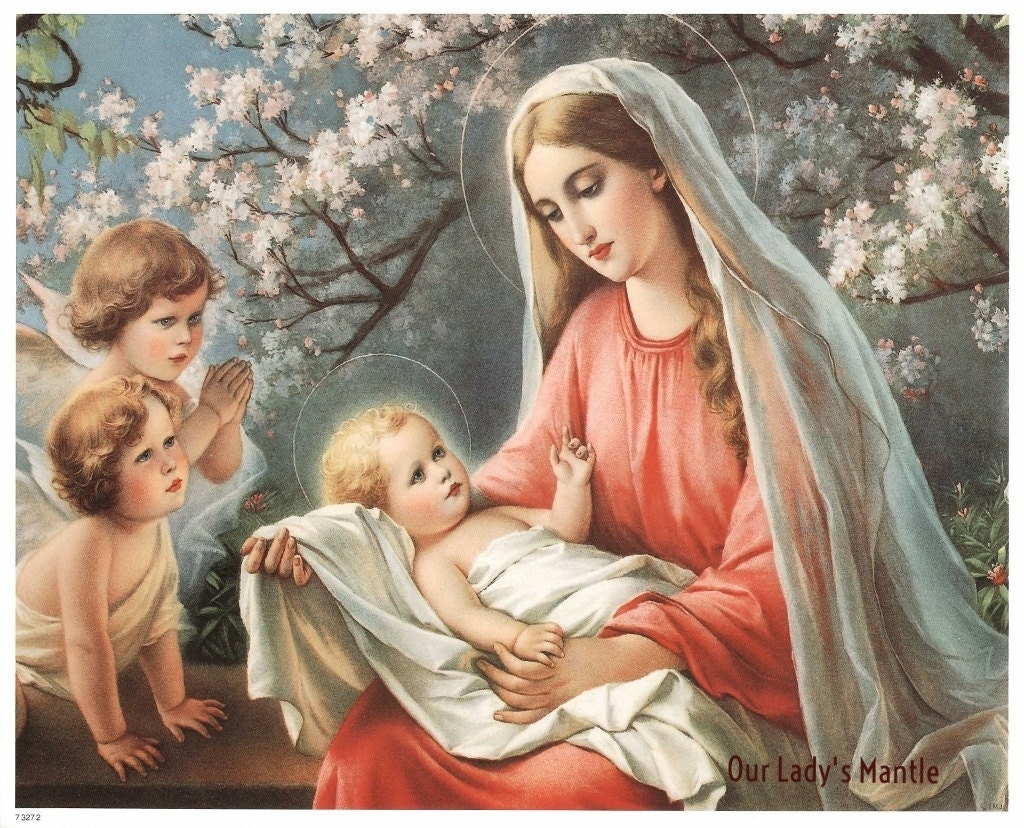
Virgin Mary with Infant Jesus and Angels - classic Catholic art

What the Saints of the Reformation Era Said

During the Protestant Reformation, Marian doctrines came under intense attack. Some Reformers still held Mary in high esteem—Luther and Zwingli among them—but many of their followers did not. So Catholic saints and scholars stood up to defend Mary’s place in Christian faith.

St. Robert Bellarmine, a Doctor of the Church, insisted that devotion to Mary doesn’t detract from Christ’s glory:

“We do not adore Mary; we adore the God whom Mary bore.”

He showed that Marian doctrine protects the truth about the Incarnation: if Mary is not truly Mother of God, then Christ is not truly God-with-us.

St. Lawrence of Brindisi and Francisco Suárez built powerful theological arguments showing that Mary’s cooperation is entirely dependent on Christ’s grace—much like ours, but in a more perfect and intimate way.

And later, the French School—think Pierre de Bérulle, Jean-Jacques Olier, St. John Eudes—emphasized Mary’s profound union with Christ’s mission. They spoke of her heart beating in harmony with His, her will wholly surrendered to His.

These saints did not invent new doctrines. They simply articulated, more clearly than ever, that Mary’s role magnifies Christ. Her greatness points to His greater greatness.

The Council of Trent: The Church Draws a Line in the Sand

The Council of Trent (1545–1563) didn’t produce a long Marian treatise, but what it did say has shaped Marian teaching ever since.

Trent reaffirmed that honoring the saints—and especially Mary—is deeply biblical and profoundly Christian. It defended the veneration of images, insisting that honor given to Mary passes directly to Christ.

When defining Original Sin, Trent explicitly stated that its decrees were not to be applied to “the Blessed and Immaculate Virgin Mary.” This left theological room for the later definition of the Immaculate Conception.

And Trent’s teaching on grace—especially the cooperation of the human will—explained how Mary could freely say “yes” to God without ever undermining Christ’s unique mediatorship.

For Catholics, Trent was like a lighthouse in the storm: steady, clear, unwavering.

What the Modern Church Teaches—With Beautiful Clarity

Fast forward to the 20th and 21st centuries, and the Church continues to speak with great tenderness and precision about Mary.

The Second Vatican Council devoted an entire chapter of Lumen Gentium to Mary. In it, the bishops wrote words that every Catholic should know by heart:

“No creature could ever be counted along with the Incarnate Word and Redeemer.”
“Mary’s role flows entirely from the superabundance of Christ’s merits.”

That settles the “co-redeemer” misunderstanding once and for all. Mary cooperates, but Christ redeems.

St. John Paul II emphasized Mary as the first and greatest disciple—the model for the whole Church.

Pope Benedict XVI reminded us that Marian devotion is always Christocentric, saying:

“Devotion to Mary... is an intrinsic part of Christian worship.”

And Pope Francis, while deeply Marian, has warned against confusing titles, saying Mary is not a “fourth person of the Trinity” and insisting we speak of her in ways that clarify—not obscure—Christ’s primacy.

The Church could not be more clear: Everything Mary does is by Christ’s grace, for Christ’s mission, and ordered to Christ’s glory.

So, in Whom Do We Put Our Trust?

Christ. Always Christ.

And because we trust Christ, we trust the Church He established. And because we trust the Church, we trust the Mother He gave us from the Cross.

Seeing Mary rightly never distracts from Jesus—it deepens our understanding of Him. Rejecting Mary doesn’t protect Christ’s glory—it diminishes our grasp of the Incarnation.

If Jesus chose to come into the world through Mary, then we can safely choose to come to Him the same way.

Birth of the Blessed Virgin Mary - Catholic Marian devotion

A Closing Prayer

Mary, Mother of God and Mother of the Church,
teach us to say “yes” as you did—freely, humbly, and with total trust.
Lead us ever closer to your Son,
that we may love Him with your heart and serve Him with your faith.
Help us understand your role in His saving work,
and draw us deeper into the mystery of His mercy.
Amen.


**If this post strengthened your faith, please—
Like, Subscribe, and Share.**
It helps more cradle Catholics rediscover the beauty of their own tradition.
To show that our trust in Christ is never threatened by honoring His Mother—it’s strengthened by it.

When the Beatitudes Feel Like They’re Talking Straight to Us

A Sunday Morning Reflection on Today’s Mass Readings

by Keith Abell, RPh MI Ad Majoram Dei Gloriam

Your long paragraph of text goes here. The text will automatically wrap around the image. Add enough text to flow past the bottom of the image for the best effect. You can add more paragraphs as needed.

If you’re reading this on a Sunday morning before or after Mass, you’ve probably just heard (or are about to hear) one of the most famous passages in the entire Gospel: the Beatitudes from Matthew 5. They’re beautiful, poetic, familiar — maybe too familiar. For lifelong cradle Catholics, they can almost slip by like religious background music.

But today’s entire set of readings invites us to hear them differently. Not as a checklist. Not as a spiritual performance review. But as God’s own encouragement spoken to people who are just trying to get through life with faith intact.

And that means you. It means me. It means the tired, the overwhelmed, the humble remnant who still show up on Sunday because we know we need God.

1. Zephaniah Reminds Us: God Sees the Strugglers

In the first reading, God says He will leave behind “a people humble and lowly.” Not the successful. Not the flawless. Not the ones with perfect spiritual résumés.

Just the ones who still seek Him in their struggle.

For many cradle Catholics, that hits home. We grew up in the faith. We know the prayers. But we also know what it feels like to show up at Mass with a heavy heart, a tired mind, or a life that feels like it’s unraveling at the edges.

Zephaniah says God sees all of that and calls us His remnant. His faithful ones. His beloved.

2. The Psalm Shows God’s Heart for the Overlooked

Psalm 146 describes the Lord as the One who “keeps faith forever,” who lifts up the bowed down, feeds the hungry, protects the stranger, and cares for the widow and orphan.

In other words, God leans toward those who feel like they’re carrying more than they can handle.

If you’ve walked into Mass today feeling stretched thin — emotionally, financially, spiritually — the Psalm is God’s gentle way of saying: “I’m here. I’m with you. I will carry you.”

3. St. Paul Reminds Us That God Chooses the Weak

Paul doesn’t sugarcoat it. He flat-out says most of the early Christians weren’t powerful, impressive, or influential. They weren’t the ones the world admired.

And then he says something astonishing: “God chose the foolish… God chose the weak… God chose the lowly…”

Not accidentally. Intentionally.

Paul’s point is simple: God works through ordinary people. People who feel their limits. People who are painfully aware of their imperfections. People who don’t feel “holy enough.”

If that’s you this morning, Paul is saying: “You’re exactly the one God loves to use.”

4. Now the Gospel Comes Alive: Jesus Is Talking To You

And then we reach the Gospel — the Beatitudes. For years, maybe decades, many of us have heard them as moral ideals: Be merciful. Be meek. Be pure. Be a peacemaker.

But look at who Jesus is blessing. Look at how He starts: “Blessed are the poor in spirit.” “Blessed are those who mourn.” “Blessed are the meek.”

These aren’t the spiritually impressive. They’re the spiritually exhausted. The emotionally drained. The quietly faithful. The ones who don’t have it all together.

Sound familiar?

Jesus isn’t giving commands. He’s giving comfort.

He’s looking out at regular people — people like us — and saying: “I see you. I know what life feels like for you. And right there, in that very place, you are blessed.”

5. The Early Church Fathers Saw It This Way Too

The early Christians weren’t living easy lives. Many were struggling, persecuted, grieving, or barely hanging on. So when the early Church Fathers wrote about the Beatitudes, they understood them as tender words of hope.

St. Augustine said the Beatitudes are like a “ladder of healing,” where God lifts up the wounded step by step.

St. John Chrysostom noted that Jesus begins His preaching with blessings for the humble and hurting so that the discouraged would know they have a place in God’s Kingdom.

Origen spoke of the Beatitudes as “medicine for the soul,” applied to people suffering inside and out.

And Gregory of Nyssa believed the Beatitudes weren’t burdens but promises—prophecies of who God is shaping us to become.

For them, the Beatitudes weren’t demands. They were declarations of God’s love for the lowly.

6. What This Means for Us This Sunday

If you walked into church today worried, lonely, stressed, or feeling spiritually “blah”… If you came in wondering where you fit in the Church or in life… If you showed up out of habit, out of hope, or out of sheer spiritual muscle memory…

Jesus has a message for you in the Gospel: “Blessed are you.”

Not “blessed will you be once you fix things.” Not “blessed are the people who have it all together.” Not “blessed are the people who pray better, try harder, or shine brighter.”

Just: “Blessed are you.” Right now. As you are.

The readings today are God’s love letter to tired Catholics who keep showing up.

A Prayer for This Sunday

Lord Jesus,

You speak blessing over the humble, the hurting, and the overwhelmed. You see what no one else sees — the quiet efforts, the hidden struggles, the longing for peace, healing, and hope. Bless me today with the comfort You promised. Give rest to my spirit, strength to my heart, and the courage to trust that Your Kingdom really is for people like me. Amen.

If this reflection spoke to your heart… Please take a moment to like, subscribe, and share this post with another cradle Catholic who might need to hear that today’s Mass readings were written for them too.

And if you ever want help crafting more reflections, I’m here for you.

Does Revelation 17 Call the Catholic Church the “Great Whore”? Let’s Talk About It

by Keith Abell, RPh MI
Ad Majoram Dei Gloriam

Defending the Faith Against a Common Misinterpretation

Back in 1998, a fundamentalist tried to shake my faith and convince me to leave the Church. One of the questions he posed was this:

“When Revelation 17 talks about the great whore and the Church tells you they can't be talking about us, in whom do you put your trust?”

It’s a question designed to plant doubt. If you’ve never thought deeply about Revelation, it can sound scary. So let’s walk through this together—because the truth is far more beautiful than the accusation.

First Things First: Who Was Revelation Written To?

Revelation wasn’t written to Catholics in 2026. It was written around the end of the first century to seven real Christian communities in Asia Minor—Ephesus, Smyrna, Pergamum, Thyatira, Sardis, Philadelphia, and Laodicea. These weren’t imaginary churches; they were vibrant communities struggling under persecution from the Roman Empire.

Why these seven? They were major hubs along a Roman postal route, making them strategic for communication. Each faced unique challenges—false teachings, complacency, outright persecution. And the number seven? In biblical symbolism, seven means completeness. So these churches represent the whole Church in every age.

So Who Is the “Great Whore”?

Here’s the big reveal: The “great whore” in Revelation 17 is not the Catholic Church. It’s a symbolic reference to imperial Rome—the empire that was persecuting Christians at the time.

How do we know?

  • Revelation calls her “Babylon.” In the Old Testament, Babylon was the city of exile and oppression. For first-century Christians, Rome was the new Babylon.
  • The text mentions “seven hills.” Rome was famously called the city on seven hills.
  • The imagery of wealth, luxury, and corruption fits Rome’s imperial system perfectly.

Why All the Symbolism?

Because writing “Rome is evil” in the first century could get you killed. Revelation was written during Emperor Domitian’s reign, a time of brutal persecution. So John used apocalyptic language—a kind of spiritual code—to encourage Christians without putting them in greater danger. The message was clear: Rome’s power is temporary. God wins.

What Did the Early Church Fathers Say?

The earliest Christian writers—people like St. Irenaeus, St. Hippolytus, St. Jerome, and St. Augustine—all agreed: Babylon = Rome. They lived through persecution. They saw friends martyred. For them, Revelation was about hope in the face of imperial oppression, not a prophecy against the Church Christ founded.

Here are some direct quotes:

St. Irenaeus (Against Heresies, Book V):
“The name Babylon is a figure of speech, signifying the city of Rome, which reigns over the kings of the earth.”

St. Hippolytus (Commentary on Daniel and Revelation):
“What John saw was the city of Rome, the seat of empire, which is built upon seven hills.”

St. Jerome:
“When John speaks of Babylon, he means Rome, for Rome is the new Babylon in its pride and persecution.”

St. Augustine (City of God):
“Two cities have been formed by two loves: the earthly city by love of self, even to contempt of God; the heavenly city by love of God, even to contempt of self.”
(Here Augustine contrasts Rome—the earthly city—with the Church, the City of God.)

Fast Forward to the Reformation

During the 1500s, some Reformers started pointing to Revelation 17 and saying, “See? The whore of Babylon is the papacy!” Saints like Robert Bellarmine and Francis de Sales pushed back hard.

St. Robert Bellarmine:
“The Church is the Bride of Christ, holy and without blemish. To call her a harlot is blasphemy against Christ Himself.”

St. Francis de Sales (The Catholic Controversy):
“The marks of Babylon—idolatry, persecution, corruption—fit pagan Rome, not the Church which has always professed the true faith.”

The Council of Trent reaffirmed something essential: Scripture must be read in harmony with apostolic tradition, not twisted to fit personal agendas.

So, In Whom Do You Put Your Trust?

That’s the heart of the question, isn’t it? Do you trust biased interpretations that rip verses out of context? Or do you trust the God who gave us His Word and the Church He founded to safeguard it?

Revelation isn’t a weapon to use against Catholics. It’s a book of hope. It tells us that no matter how dark things look, Christ wins. The Church He built will endure—just as He promised.

A Short Prayer

Lord Jesus, You are the Alpha and the Omega, the beginning and the end. Strengthen our faith when doubts arise. Help us trust in Your Word and Your Church, and give us courage to share Your truth with love. Amen.

If this helped you see Revelation in a new light, please like, share, and subscribe so more Catholics can rediscover the beauty and truth of their faith. And don’t stop here—this is part of a whole series answering tough questions posed by a fundamentalist who tried to shake my faith. Start with the first question on the Sacraments and journey with me through the rest.

God bless you!

Do Catholics Worship Statues?

Do Catholics Worship Statues? The Truth About Graven Images That Every Cradle Catholic Needs to Know

“When the Church tells you it’s OK to make graven images, statues, and idols and proudly display them in your churches and homes, and when God commanded you not to do so, in whom do you put your trust?”

Welcome back to our 20-part series, “In Whom Do You Put Your Trust?” These posts are inspired by real questions from a fundamentalist who tried to shake my faith as a cradle Catholic. Like many of us, I grew up Catholic but never really dug into the foundations of what we believe. When these questions came, I realized I needed answers—not just for myself, but for other cradle Catholics who might face the same challenges from friends or family outside the Church.

Today we tackle Question 11, and it’s a big one: “Doesn’t the Bible say not to make graven images? So why do Catholics have statues, medals, and relics?”

If you’ve ever been confronted with this, you know how uncomfortable it can feel. Let’s walk through this together.

The Commandment in Question

Exodus 20:4–5 says, “You shall not make for yourself an idol, whether in the form of anything that is in heaven above, or that is on the earth beneath, or that is in the water under the earth. You shall not bow down to them or worship them; for I the Lord your God am a jealous God.”

Our Protestant brothers and sisters often quote this to us. And honestly? At first glance, it sounds like Catholics are breaking this commandment every time we put a statue in a church. But here’s the key: the commandment is about worship, not art. God forbids making idols and bowing down to them as if they were gods. The sin isn’t in making an image—it’s in worshiping it.

God Himself Commanded Images

Here’s something fascinating: right after giving the Ten Commandments, God tells Moses to make golden cherubim for the Ark of the Covenant (Exodus 25:18–22). He even commands that their images be woven into the tabernacle curtains (Exodus 26:1, 31). Later, in Numbers 21:8–9, God instructs Moses to make a bronze serpent that heals anyone who looks at it. If making any image were sinful, these commands would contradict His own law!

King Solomon also decorated the Temple with images of cherubim, lions, oxen, and palm trees (1 Kings 6–7). Clearly, the problem isn’t the existence of an image—it’s worshiping that image as if it were divine.

God Can Use Material Things as Instruments of Grace

This isn’t just an Old Testament thing. Throughout Scripture, God uses physical objects to convey His power:

  • Numbers 21:8–9 – The Bronze Serpent
    The Israelites were dying from snake bites. God didn’t just say, “Pray.” He told Moses to make a bronze serpent and put it on a pole. Whoever looked at it lived. The healing came from God, but He chose to work through a physical object.
  • 2 Kings 13:20–21 – Elisha’s Bones
    A dead man was thrown into Elisha’s grave. When his body touched Elisha’s bones, he came back to life. God’s power worked through the prophet’s remains.
  • Acts 19:11–12 – Paul’s Handkerchiefs and Aprons
    People took cloths that had touched Paul and laid them on the sick. Diseases left them, and evil spirits fled. The power wasn’t in the fabric—it was in God.
  • Acts 5:15–16 – Peter’s Shadow
    People lined the streets so Peter’s shadow might fall on them. And they were healed! If God can work through a shadow, He can certainly work through a medal or a relic.

These examples show that God is not limited. He can use material things as channels of grace. The danger isn’t in the object—it’s in forgetting that the power comes from God alone.

Why Catholics Use Statues and Sacramentals

Catholics use statues, medals, and relics—called sacramentals—as reminders of God and His saints. They’re not magic charms, and they’re certainly not gods. They help us focus on prayer and holiness. When you see a crucifix, it reminds you of Christ’s sacrifice. When you wear a medal of a saint, it reminds you of their example of faith. These objects point us toward God, not away from Him.

Unfortunately, some people misunderstand this and accuse Catholics of idolatry. But the Church is clear: worship belongs to God alone. Sacramentals are tools, not substitutes for God.

What the Early Church Fathers Really Said About Images and Sacramentals

The early Christians weren’t living in a vacuum—they were surrounded by Roman temples filled with statues of pagan gods. Idolatry was everywhere. So, what did the Fathers say?

  • Tertullian (c. 160–220): Called idolatry “the chief crime of humanity,” condemning worship, not art.
  • St. Augustine (354–430): “We do not worship images as gods… The honor given to the image passes to its prototype.”
  • St. John of Damascus (c. 675–749): “I do not worship matter; I worship the Creator of matter who became matter for my sake… I honor all matter through which salvation came to me.”
  • St. Cyril of Jerusalem (c. 313–386): Encouraged bold use of the sign of the cross as a seal of faith.
  • St. Ambrose (c. 340–397): “We love the martyrs… We do not adore them, but we venerate their memory.”

The Fathers were united: Idolatry forbidden. Images and sacramentals permitted when they lead to God. Worship to God alone.

The Heart of the Matter

The commandment warns against idolatry—placing anything before God. Making an image is not the sin. Worshiping that image as if it were God is the sin. Our trust must always remain in Him alone.

So, in whom do you put your trust? Not in statues, medals, or relics—but in the living God who sometimes chooses to work through them. Our faith is in Him, and Him alone.

Closing Prayer

Heavenly Father,
Thank You for the gift of faith and the reminders You give us through sacramentals. May the crucifix on our wall, the rosary in our hands, and the medal around our neck never become objects of worship, but tools to draw us closer to You. Help us to honor Your saints as examples of holiness and to keep our hearts fixed on You alone.
Through Christ our Lord.
Amen.

Join the Conversation

What do you think about this question? Have you ever been challenged on the use of statues or medals? Share your thoughts in the comments below—I’d love to hear your experiences.

If this post helped you, please like, share, and subscribe so more Catholics can grow confident in their faith. And stay tuned for Question 12, where we tackle another tough claim, “The Catholic Church is a false prophet.”

You won’t want to miss it!

When the Church tells you that Jesus comes down to the altar, to be sacrificed, and Jesus said ‘It is finished’, in whom do you put your trust

If Jesus Said “It Is Finished,” Why Do Catholics Believe He Comes to the Altar?

by Keith Abell RPh MI
Ad Majorem Dei Gloriam
(Question 5 of the “In Whom Do You Put Your Trust?” Series)


This is question 5 in my 18-part series responding to questions raised by a fundamentalist who challenged my Catholic faith years ago. These questions aren’t easy—they’re designed to shake confidence in what we believe. And if you’re a cradle Catholic who has “just gone with it” all your life, this series is for you. Because understanding your faith isn’t optional. It’s essential.

Today’s question is one that has confused many Catholics and divided Christians for centuries:

“When the Church tells you that Jesus comes down to the altar, at the beck and call of a priest to be sacrificed, and Jesus said ‘It is finished’ and that by one offering man can have salvation, in whom do you put your trust?”

At first glance, this sounds convincing. After all, Jesus did say “It is finished” on the Cross (John 19:30). So why do Catholics believe the Eucharist is truly Christ—Body, Blood, Soul, and Divinity—made present at every Mass? Why do we believe the sacrifice of Calvary is present on the altar? And in whom do we put our trust—Christ alone, or Christ and the Church He founded?

Let’s dig deep, because this question strikes at the heart of the Catholic faith.

The Misunderstanding

The accusation that Jesus comes down “at the beck and call of a priest” misrepresents Catholic teaching. The Church does not teach that priests summon Christ or sacrifice Him again. The Mass is not a new sacrifice. It is the one sacrifice of Calvary made present sacramentally.

At every Mass, we obey Jesus’ command, “Do this in memory of me” (Luke 22:19).

This is not human power at work. It is God’s action through Christ and the Holy Spirit. The priest acts in persona Christi—in the person of Christ—praying to the Father through the Son, while the Holy Spirit transforms bread and wine into the Body, Blood, Soul, and Divinity of Jesus. This is why the Catechism calls the Eucharist “the source and summit of the Christian life.”

What Did Jesus Mean by “It Is Finished”?

When Jesus said “It is finished” (John 19:30), He was declaring the completion of His Paschal sacrifice—the fulfillment of the Old Covenant Passover.

At the Last Supper, Jesus began the Passover meal but did not drink the final cup. He said, “I shall not drink again of the fruit of the vine until the kingdom of God comes” (Luke 22:18).

On the Cross, He drinks from the sponge on the hyssop stick (John 19:29), completing the Passover. His blood and water flow from His side, making Him the true Paschal Lamb. The old Passover is finished because Jesus Himself becomes the Passover. The Eucharist is now the New Passover, and when we celebrate it, we are mystically present at Calvary, united to that one eternal sacrifice.

One Sacrifice, Once for All

Hebrews 10:10 says Christ’s offering is “once for all.” The Mass does not repeat that sacrifice—it applies its grace to us here and now. The Eucharist is not a symbol. It is Christ Himself, the same Jesus who died and rose for us. At every Mass, heaven touches earth, and we receive the living Christ who said:

“I am the living bread that came down from heaven; whoever eats this bread will live forever” (John 6:51).

And again:

“Unless you eat the flesh of the Son of Man and drink his blood, you do not have life within you” (John 6:53).

This is why Catholics respond as Peter did:

“Lord, to whom shall we go? You have the words of eternal life” (John 6:68).

Why We Trust Jesus—and His Church

Here’s the heart of the matter: we trust Jesus, and we trust the Church He founded. Jesus promised:

“You are Peter, and upon this rock I will build my Church, and the gates of hell shall not prevail against it” (Matthew 16:18).

After the Reformation, thousands of interpretations of Scripture emerged. But Christ gave us the Church as the pillar and foundation of truth (1 Timothy 3:15). He guaranteed that the gates of hell would not prevail against it. That means the Church, guided by the Holy Spirit, safeguards the truth of the Eucharist.

The Witness of the Early Church Fathers

From the very beginning, Christians believed the Eucharist is truly Christ:

  • St. Ignatius of Antioch (c. 107 AD) wrote, “They abstain from the Eucharist because they do not confess that the Eucharist is the flesh of our Savior Jesus Christ.”
  • St. Justin Martyr (c. 155 AD) said, “We do not receive these as common bread and drink; but as Jesus Christ our Savior being incarnate… so we have been taught that the food blessed by the prayer of His word is the flesh and blood of that Jesus.”
  • St. Irenaeus (c. 180 AD) affirmed, “The bread which is produced from the earth, when it receives the invocation of God, is no longer common bread, but the Eucharist consisting of two realities, earthly and heavenly.”

This is not a medieval invention. It is the faith of the early Church—the same faith we profess today.

Conclusion

The Eucharist is not a symbol. It is Christ Himself, the same Jesus who said “It is finished” and offered His life for us. At every Mass, we are united to His one sacrifice—the Paschal Mystery—made present by His power.

So, in whom do we put our trust? In Jesus Christ, who gives Himself to us as spiritual food for eternal life. And in the Church He founded, which has faithfully taught this truth for 2,000 years. Jesus Himself guaranteed this when He said:

“And I tell you, you are Peter, and on this rock I will build my church, and the gates of hell shall not prevail against it.” (Matthew 16:18)

This promise matters. It means the Church will never be overcome by error or destruction. It means the truth of the Eucharist is safeguarded by Christ Himself.

Next time you go to Mass, pause and remember: you are not just attending a ritual—you are standing at Calvary. You are at the foot of the Cross, united to the one eternal sacrifice of Jesus Christ. Let that reality transform the way you worship.

If this post helped you understand the Paschal Mystery more deeply, share it with someone who needs to know the truth about the Eucharist. And don’t forget to subscribe or follow this series so you won’t miss Part 6, where we’ll tackle another challenge to our Catholic faith.


Prayer for Understanding the Paschal Mystery

Lord Jesus Christ, open our hearts and minds to the mystery of Your love. Help us to see the Eucharist as Your true Body and Blood, given for our salvation. Deepen our faith so that we may never take this gift for granted. Unite us to Your sacrifice and make us living witnesses of Your presence in the world. Amen.

So when the Church tells you that the Sacraments are necessary for salvation, and Jesus taught that only belief was necessary, in whom do you put your trust? Part 6: Holy Orders

Faith and the Sacraments: Trusting What Jesus Actually Taught

Part 6: Holy Orders – Shepherds for the Flock

“So when the Church tells you that the Sacraments are necessary for salvation, and Jesus taught that only belief was necessary, in whom do you put your trust?”

Welcome to Part 6 of our 7-part series exploring the Sacraments and answering one of the most important questions Catholics face today: If Jesus taught that belief alone is necessary for salvation, why does the Catholic Church teach that the Sacraments are necessary?

When I first began responding to the challenges from a fundamentalist Christian back in 1998, I already knew that Holy Orders was a sacrament, instituted by Christ and essential to the life of the Church. I had a deep respect for priests and bishops and understood their role in leading and sanctifying the faithful. But what I hadn’t yet explored was where this sacrament comes from in Scripture, and how it connects the Old Testament priesthood with the New Covenant ministry of Christ and His apostles.

That same fundamentalist had asked me:

“If Jesus taught that belief alone is necessary for salvation, why does the Catholic Church teach that the Sacraments are necessary?”

And once again, the answer led me deeper — into the Old Testament, where God established a priesthood to serve His people, and into the New Testament, where Jesus fulfilled and transformed that priesthood, commissioning His apostles to continue His work through the Sacrament of Holy Orders.

In this post, we’ll explore:

  • The biblical foundations of Holy Orders,
  • Its continuity from the Old Testament priesthood,
  • How Jesus commissioned His apostles to carry on His mission, and
  • What the early Church Fathers and saints taught about the sacredness of ordination.

Faith Alone? Why Holy Orders Matter

Jesus didn’t just call people to believe — He called and commissioned specific men to teach, sanctify, and govern His Church. He gave them real authority, and through the Sacrament of Holy Orders, that authority has been passed down through apostolic succession for over 2,000 years.

2 Corinthians 5:20 – “We are ambassadors for Christ, as though God were making His appeal through us.”

The ordained priesthood is not a human invention — it is a divine calling, a continuation of Christ’s own priestly ministry.

Biblical Foundations of Holy Orders

Old Testament Priesthood

  • Exodus 28–29 – God commands Moses to consecrate Aaron and his sons as priests, with sacred garments and rituals.
  • Numbers 3:5–10 – The Levites are appointed to assist the priests and serve in the tabernacle.
  • Psalm 110:4 – “You are a priest forever, in the order of Melchizedek.”

These passages show that God established a ministerial priesthood distinct from the general priesthood of all believers — a pattern fulfilled and transformed in Christ.

Jesus Establishes the New Priesthood

  • Luke 22:19 – At the Last Supper, Jesus says: “Do this in memory of me.” This is a command to offer the Eucharist, a priestly act.
  • John 20:21–23 – Jesus breathes on the apostles and gives them authority to forgive sins — a priestly function.
  • Matthew 28:19–20 – Jesus commissions the apostles to teach, baptize, and lead — the core duties of ordained ministry.

These weren’t symbolic gestures. Jesus was establishing a sacramental priesthood, rooted in His own authority.

Apostolic Succession and Ordination

The apostles understood that their ministry was not temporary — it was to be handed on:

  • Acts 6:5–6 – The apostles lay hands on the first deacons.
  • Acts 13:2–3 – Paul and Barnabas are commissioned through prayer and laying on of hands.
  • 1 Timothy 4:14 – “Do not neglect the gift you have, which was given you… when the council of elders laid their hands on you.”
  • 2 Timothy 1:6 – “Fan into flame the gift of God, which is in you through the laying on of my hands.”

This laying on of hands is the essential act of ordination, still used today in every Holy Orders ceremony.

What the Early Church Believed About Holy Orders

St. Clement of Rome (1st century)

“The apostles appointed bishops and deacons… and gave instructions that when these should fall asleep, other approved men should succeed them.”

St. Ignatius of Antioch (c. 110 A.D.)

“Let everyone respect the bishop as they would the Lord Himself.”

St. John Chrysostom

“The priesthood is the most sublime of all orders… it is exercised on earth, but ranks among heavenly things.”

St. Thomas Aquinas

“Holy Orders is the sacrament through which the spiritual power is conferred for the sanctification of souls.”

The early Church saw Holy Orders as a divine institution, not a human hierarchy. It was the means by which Christ continued to shepherd His people.

Conclusion: Shepherds for the Flock

Holy Orders is not about status — it’s about service. It’s not about authority for its own sake — it’s about sacrificial leadership, modeled after Christ the Good Shepherd.

So when someone asks, “If Jesus taught that belief alone is necessary for salvation, why does the Catholic Church teach that the Sacraments are necessary?” — we can answer:

Because Jesus didn’t just say “believe.” He said, “Feed my sheep.” He gave us the priesthood to continue His ministry of teaching, healing, and sanctifying.

Stay Tuned for Part 7: Anointing of the Sick – Grace in Suffering

In the final post of this series, we’ll explore the Sacrament of Anointing of the Sick, a powerful gift of healing, peace, and grace for those who are suffering. We’ll look at its biblical roots, its presence in both Old and New Testaments, and how the Church continues Christ’s healing ministry today.

Follow our Facebook page to stay updated and join the conversation as we conclude this journey through the Sacraments — one post at a time.

Most Popular Posts