A Conversation with Cradle Catholic Families — With Wisdom From Scripture and the Early Church Fathers

This Week’s Sunday Readings: A Conversation with Cradle Catholic Families — With Wisdom From Scripture and the Early Church Fathers

This Week’s Sunday Readings: A Conversation with Cradle Catholic Families — With Wisdom From Scripture and the Early Church Fathers

If you grew up Catholic, you probably know the rhythm of the faith by heart. You learned the prayers before you understood them. You knew when to sit, when to stand, when to kneel. You grew up hearing the Gospel every Sunday, receiving the sacraments at the usual milestones, saying grace before meals, and trying your best to be “a good Catholic kid.”

But as the years passed, the world got louder. Busier. More divided. More distracting. And somewhere between raising kids, managing schedules, worrying about the future, and keeping up with everything happening in society, your faith may have slipped into the background—not rejected, just quiet.

You believe.
You still show up.
But sometimes it feels like you’re praying, listening, or attending Mass on autopilot.

If that’s you, you’re not alone. In fact, the readings for this Sunday—and the wisdom of the early Church fathers—speak directly to this quiet ache many cradle Catholic families feel today.

Let’s walk through what these readings mean for us, not as scholars, but as ordinary families doing our best to keep the faith alive in a world that often works against it.

Sirach: Choosing God in a Culture That Pulls Us Away

Sirach was written during a time when Jewish families were surrounded by Greek culture—strong, influential, and tempting. Many felt pressured to blend in.

Our modern world isn’t all that different. Faith can quickly become something you “fit in when you can,” rather than the anchor that shapes daily life.

Sirach reminds us of something freeing:
God gives us real choice. Real freedom. Real dignity.

St. Justin Martyr would later echo this truth in the second century. Living in a world suspicious of Christians, he insisted that God invites but never forces. “We are not compelled by God,” he wrote, “but persuaded by the truth.”

In other words, if faith feels heavy sometimes, remember:
God is not imposing a burden.
He’s offering a relationship.

And relationships thrive on willingness, not pressure.

Psalm 119: Rediscovering Wonder in Familiar Faith

Psalm 119 comes from a time when the Jewish people were rebuilding their identity after exile. They weren’t spiritually on fire—they were spiritually rebuilding.

That’s something many cradle Catholics understand deeply.

We learned the rules growing up, but we didn’t always learn the beauty behind them. And when life gets busy, those rules can feel hollow or routine.

The psalmist’s prayer—“Open my eyes… teach me… give me understanding”—is the prayer of someone who wants their faith to feel alive again.

St. Augustine understood this longing. He grew up knowing the faith intellectually but didn’t fall in love with God until adulthood. His famous words, “Late have I loved You,” echo the heart of every Catholic who desires renewal.

Psalm 119 reminds us:
It’s okay if you’re rediscovering God later.
It’s okay if your faith feels unfamiliar or new again.
It’s okay to ask God to open your eyes.
In fact, it’s holy.

Paul and the Early Church: Living Faith in a Loud Culture

Corinth was noisy, opinionated, competitive, and full of philosophical debates. The early Christians there wondered if believing in Christ made them look foolish.

Sound familiar?

St. Ignatius of Antioch lived in a similar world. He faced external pressure, political division, and even persecution, yet he encouraged Christians to remain steady—not by arguing louder, but by living differently.

Paul’s message to the Corinthians, and Ignatius’s message to the early Church, are the same message we need today:

Your faith isn’t outdated.
Your beliefs aren’t naïve.
Your desire to raise a family grounded in Christ isn’t old-fashioned.

God’s wisdom has always looked different from the world’s wisdom.

And that’s okay.

Jesus in Matthew: God Wants Your Heart, Not Your Perfection

When Jesus deepens the commandments in Matthew 5, He doesn’t do it to make life harder. He isn’t adding burdens. He’s getting to the heart.

He’s saying that faith isn’t about performing the right actions; it’s about becoming the right person.

St. John Chrysostom preached this passionately:
Christianity isn’t about external compliance—it’s about interior transformation.

Jesus knows the pressures families face. He knows how complicated life can be. He knows we struggle with anger, temptation, frustration, and relationships. And He speaks straight into those real places—not to shame us, but to free us.

For cradle Catholics juggling everything modern life throws at them, this is incredibly hopeful.

You don’t need to be perfect.
You don’t need to have all the answers.
You don’t need spiritual fireworks.

You just need a heart that keeps turning toward Him.

What Their World and Our World Have in Common

The early Church lived in a society that was divided, suspicious, morally confused, politically charged, and spiritually shallow.

Our world is much the same.

And yet, the Church not only survived—it grew.
Not because Christians were perfect, but because they kept choosing Christ one honest, intentional step at a time.

Their message to us today would be simple:
Don’t give up.
Don’t be discouraged.
Don’t underestimate what God can do with a willing, imperfect heart.

A Final Word of Encouragement

If your faith feels like it’s been on cruise control, if the culture feels overwhelming, or if you’re just trying to raise kids with even a mustard seed of faith in a confusing world, you’re not alone.

You’re walking the same path as millions of Catholics before you.
Your longing for a deeper faith is not a weakness.
Your tired but willing heart is not a disappointment to God.

It’s the very place He begins His work.

You don’t need to overhaul your whole life.
You just need to let Christ open your eyes again—gently, slowly, lovingly.

And He will.

Closing Prayer Inspired by the Early Church Fathers

Lord Jesus Christ,
You who walked with the first believers through a world as divided and restless as our own, walk with us now.
Open our hearts the way You opened the hearts of Augustine and Ignatius,
so that we may rediscover the beauty we’ve grown too familiar with.

Stir in us the quiet courage of Justin Martyr,
that we may choose You freely each day,
not out of habit, but out of love.

Give us the steady hope of Chrysostom,
who trusted that Your grace reaches into the deepest parts of the human heart
and transforms us from the inside out.

Teach us, as You taught the early Church,
to live our faith gently, joyfully, and authentically
in the middle of a noisy and uncertain world.

Bless our families, especially those of us who grew up in the faith
and now desire to see it come alive again.
Renew in us the wonder of being Your disciples.
Strengthen us when we feel tired.
Guide us when we feel lost.
And remind us that You are always near,
inviting us into deeper life, one small step at a time.

May we walk forward with new eyes,
new desire,
and new trust in Your unfailing love.

Amen.

A Gentle Call to Action

If this reflection spoke to your heart—or reminded you that you’re not alone on this journey—I’d love for you to stay connected.

Take a moment to like, subscribe, and share this post with other cradle Catholic families who might need a word of encouragement today.

Your support helps build a community where ordinary Catholics can rediscover faith, hope, and joy together.

Thank you for reading, thank you for walking this journey with me,
and may God bless you and your family today.
Discovering Our Lady of Good Success in a Time That Desperately Needs Her

Discovering Our Lady of Good Success in a Time That Desperately Needs Her

Discovering Our Lady of Good Success in a Time That Desperately Needs Her

A prophetic Marian devotion that speaks directly to our troubled times—with hope, not despair.

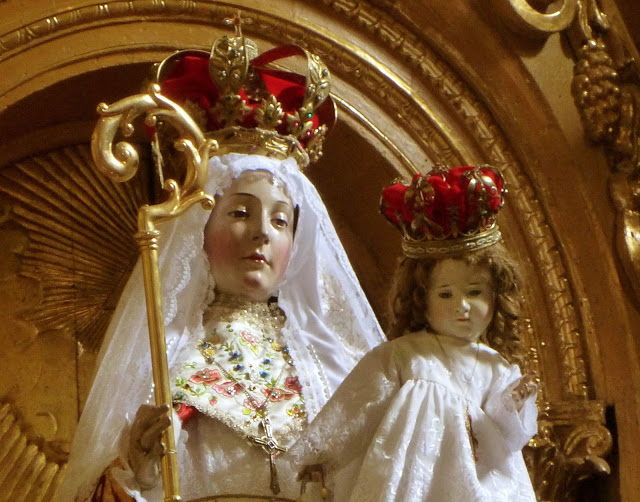
Statue of Our Lady of Good Success in Quito, holding the Christ Child, crosier, and keys

Every once in a while as a cradle Catholic, you come across something in the vast treasury of our faith that makes you stop in your tracks and wonder how on earth you’d never heard about it before. That was my experience with Our Lady of Good Success. What started as a passing curiosity quickly became a deep dive into one of the most striking, prophetic, and hope-filled Marian apparitions I’ve ever encountered.

The more I learned, the more convinced I became that this devotion isn’t just historical trivia. It speaks directly to the world we’re living in right now.

The Name That Throws Everyone Off

Let’s start with the name, because if you’re anything like me, “Good Success” immediately makes you think of achievement and personal victories and all the self-help language we’ve absorbed over the years. But when Mary appeared in Quito in the early 1600s, the Spanish term she used—Buen Suceso—meant something completely different.

Back then, “suceso” meant an event or a happening, specifically a good event brought about by God’s providence. It was connected to one of the most beautiful feasts in the Church: the Presentation of Jesus in the Temple, also known as Candlemas. So the title doesn’t really mean “Our Lady who helps you accomplish things,” but Our Lady of the Good Event, the Lady of God’s perfect fulfillment.

Once you understand that, the entire devotion opens up. This title points us straight into the mystery of Jesus being revealed as the Light to the nations, and Mary presenting Him to the world. It’s right there in Simeon’s prophecy. This is a Marian title rooted in hope, in promise, and in God’s triumphant plan.

The Presentation of Jesus in the Temple (Candlemas), classical Catholic art

A 400-Year-Old Message That Sounds Like It Was Written Yesterday

What truly sets this apparition apart is how plainly Mary said her message wasn’t mainly for the 1600s. It was for a future age—she explicitly mentioned the 20th century. She spoke of a coming time when confusion would enter the Church, when families would suffer, when purity would be attacked, when children would be targeted, when vocations would decline, and when scandals would shake the faithful.

Reading her words today feels less like a prophecy and more like a commentary on the world we’re already living in.

But this is where Mary’s maternal heart shines through. She doesn’t warn us to intimidate or frighten. She warns us to prepare us, to protect us, and to call us back to the only place where we can find peace: her Son.

Mary Never Warns Without Offering a Remedy

What I love about Marian apparitions—whether in Quito, Fatima, Lourdes, La Salette, or Akita—is that Heaven’s message never stops at “Here’s what’s going wrong.” Mary always gives a clear path forward, a spiritual antidote for the illness of the age.

In the messages of Our Lady of Good Success, her solution is the same remedy she has repeated throughout history. She calls us to prayer, especially the Rosary, not simply as a devotion but as a lifeline. She urges us toward penance and acts of reparation, united with Christ for the salvation of souls. She insists that we hold tightly to the sacraments, especially the Eucharist and Confession, because a time would come when they would be ignored, neglected, or even abused. She invites us to conversion—not dramatic episodes necessarily, but humble, daily fidelity. And she encourages us to consecrate ourselves to her maternal protection, trusting that she is guiding the Church through its darkest valleys.

These are not new instructions. They are the timeless practices the Church has always needed, but Mary knew we would need them most in the era she foresaw.

The Statue That Heaven Asked For

One of the most beautiful details in this apparition is Mary’s request for a statue in her honor—one that she said would be a source of consolation, faith, and protection for centuries. Tradition holds that when the sculptor could not complete it perfectly, angels finished it themselves.

This statue, still venerated in the Convent of the Immaculate Conception in Quito, shows Mary holding the Christ Child and carrying a bishop’s crosier, symbolizing her guardianship of the Church. At her side hang keys, representing authority and safekeeping. Everything about her posture and expression communicates that she is not merely watching over the Church—she is actively defending and guiding it.

The miraculous statue of Our Lady of Good Success enthroned in Quito

How Catholics Are Living This Devotion Today

Even though this apparition was little-known outside Ecuador for centuries, it has begun to spread rapidly as people sense its relevance. Many Catholics celebrate the feast on February 2nd, uniting it with the beautiful traditions of Candlemas and the blessing of candles. Others pray the novena leading up to the feast, asking Mary’s intercession for the Church, their families, and the world.

Devotion to the Child Jesus is also part of this spirituality, since Mary appears holding Him. Some Catholics keep an image of the statue in their homes, asking for her maternal protection in a confused and often hostile world. There is also growing interest in the life of Mother Mariana de Jesús Torres, whose holiness and sufferings were deeply united with the future struggles of the Church.

The heart of all these devotions is simple: trust. Trust that Mary is present. Trust that God is still guiding His Church. Trust that darkness never has the final word.

A Message Not of Despair, but of Triumph

I think what moved me most in this whole journey is that Mary doesn't hem and haw about how bad things will get. She’s honest. She’s clear. But she is not bleak. Every warning she gives is wrapped in hope. She promises that after the storm, after the purification, after the trials, there will be renewal. There will be restoration. And ultimately, there will be triumph.

Her title itself—Good Success—reminds us that God’s plan ends well. That the Presentation of Jesus wasn’t just a historical moment, but a symbol of the entire story of salvation: the Light shining in the darkness, and the darkness never overcoming it.

Why This Devotion Matters So Much Right Now

In a world where so much feels unsteady, where even the Church can seem shaken, devotions like this steady the soul. They remind us that heaven knows what’s happening. That heaven has spoken into our moment. That heaven has not left us to figure this out alone.

If you’ve never prayed to Our Lady of Good Success before, this might be the perfect time to start. Light a candle on February 2nd. Pray a novena. Ask for her protection over your home, over your children, and over the Church.

And remember: the “success” she speaks of isn’t ours to manufacture. It’s the good outcome God has already written. We are simply living our chapter of the story.

Closing Prayer

O Mary,

Our Lady of Good Success,
Mother who guides us through confusion and lifts our hearts toward hope,
wrap us in your mantle of protection.

Teach us to trust in God’s plan even when the world seems dark,
and help us stay faithful to prayer,
to the sacraments,
and to your Son’s loving call.

Strengthen our families,
renew the Church,
and lead us always to Jesus.

Amen.

Call to Action
If this reflection spoke to your heart, I’d love for you to like, subscribe, and share. Your support helps this message reach others who may need the hope and clarity Our Lady offers. Let’s keep growing together in faith!

Most Popular Posts